Tajweed Symbols Guide — Quranic Stop Signs Explained
Master the art of Quranic recitation with our comprehensive guide to Waqf and diacritics.
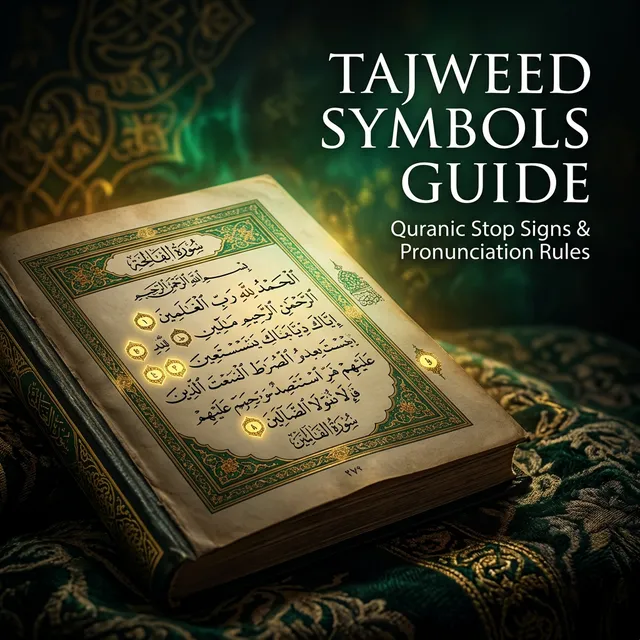
Waqf (Stop) Signs
Waqf signs indicate whether a reciter should stop, pause, or continue at a particular point in the Quran.
Mu'anaqah — The Linked Stops
The mu'anaqah (معانقة) is a unique pair of stop signs that appear at two places in the same verse. They look like three dots arranged in a triangle (∴ and ∵). The rule is:
- If you stop at the first sign, you must continue past the second.
- If you stop at the second sign, you must continue past the first.
- You cannot stop at both — the meaning changes if you do.
Hamza Variants
Hamza (the glottal stop) appears in several forms in Arabic, each with a specific usage rule:
Quranic Diacritics
Beyond standard harakat, the Quran uses several special diacritical marks unique to Quranic script:
- Khanjariyya (ٰ) — a small vertical alef indicating a prolonged "aa" sound
- Small waw (ۅ) and small ya (ۆ) — indicate prolonged "oo" and "ee" sounds in Uthmani script
- Sajdah mark (۩) — marks a verse requiring prostration (sujood)
- Hizb mark (۞) — marks a quarter of a Juz' (section of Quran)
Maddah — The Prolongation Marks
Maddah signs tell the reciter to elongate a vowel sound for a specific number of counts (harakāt):
- Natural Madd (مد طبيعي) — 2 counts, occurs with alef, waw, or ya after a matching vowel
- Connected Madd (مد متصل) — 4–5 counts, when a madd letter is followed by hamza in the same word
- Separated Madd (مد منفصل) — 2–5 counts, when a madd letter is followed by hamza at the start of the next word
Type Tajweed symbols right now
Free virtual keyboard with 35+ Tajweed and Quranic marks.
⌨ Open Arabic Keyboard